
We know home theater - 26th Anniversary
Questions? CALL TOLL FREE 1-888-764-9273


Motion pictures began as a visual invention, but sound quickly became inseparable from the moviegoing experience. Even during the so-called silent era, audiences usually heard music, sound effects and sometimes live narration. Over the next century, cinema sound moved from musicians performing beside the screen to synchronized records, optical soundtracks, multichannel magnetic film, Dolby Stereo, digital 5.1 and finally Dolby Atmos.
Each technical step changed more than volume or fidelity. Sound altered acting, editing, theater architecture and the way filmmakers direct an audience's attention. A voice could come from behind a closed door. A train could cross the auditorium. Rain could surround the listener. With Dolby Atmos, an individual sound can move through three-dimensional space and pass overhead.
The phrase “silent film” refers to the absence of a synchronized recorded soundtrack, not to a silent theater. Early screenings were commonly accompanied by a pianist, theater organist, small musical ensemble or full orchestra. Larger movie palaces could employ substantial orchestras, while neighborhood theaters worked with whatever musicians and instruments they could afford.
Music helped establish mood, cover projector noise, connect scenes and guide the audience's emotional response. Musicians might improvise, follow published cue sheets or perform a score assembled for a particular production. Theater organs could imitate bells, whistles, drums and other effects in addition to providing music.
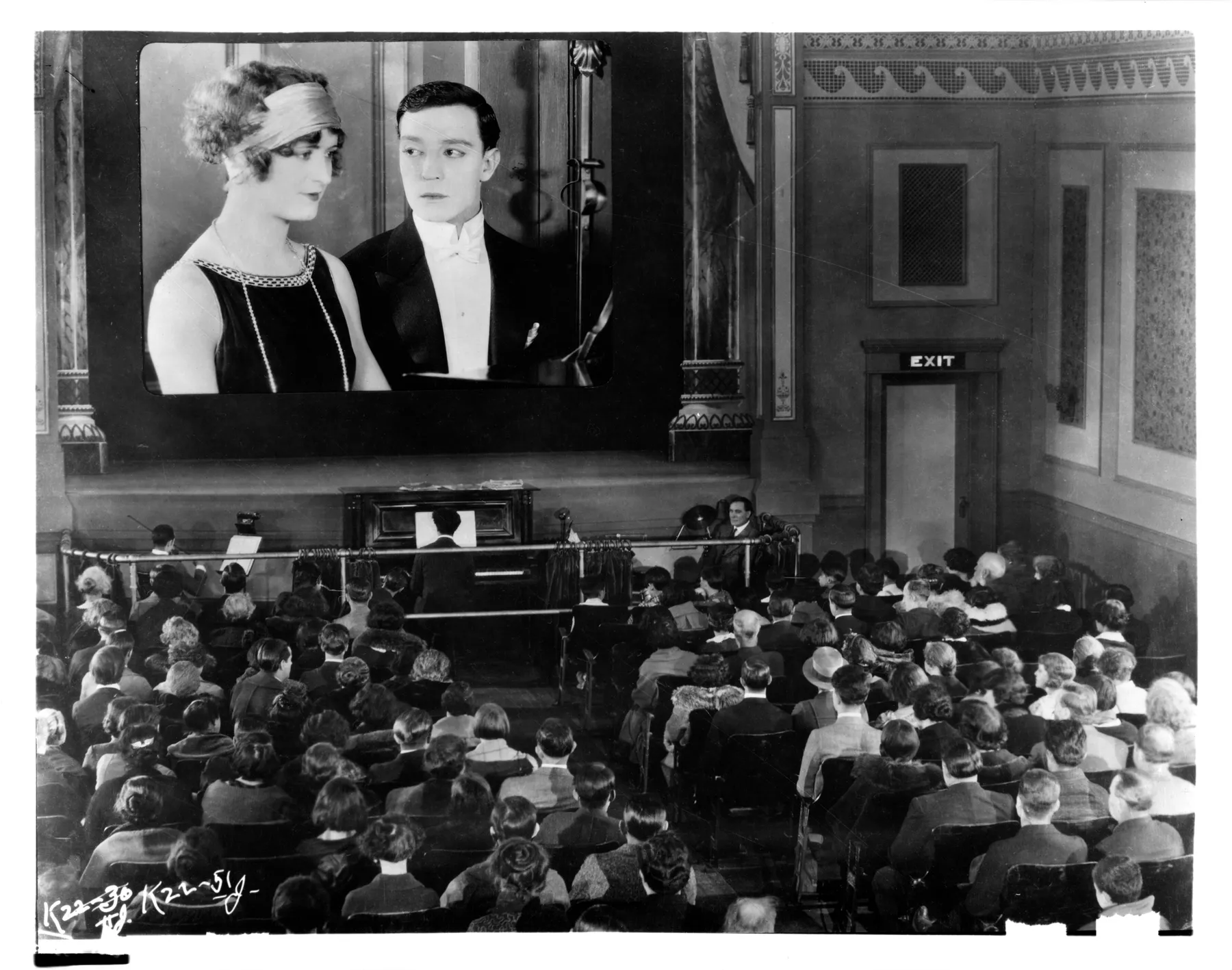
The quality of the presentation therefore varied from theater to theater. The same film might be accompanied by a lone pianist in one town and a carefully rehearsed orchestra in a major-city movie palace. Before recorded sound standardized the experience, the theater itself participated in creating the soundtrack.
Inventors experimented with connecting motion pictures to phonographs almost from the beginning of cinema. The basic problem was synchronization. The picture and record had to start at the correct moment and remain at the same speed. If the film broke, skipped or was repaired, the recorded sound could drift noticeably away from the action.
Lee De Forest demonstrated his Phonofilm sound-on-film process during the 1920s. It recorded sound photographically along the film rather than on a separate disc, but major studios did not initially adopt it for feature production.
Warner Bros. achieved greater commercial momentum with Vitaphone, a sound-on-disc system developed with Western Electric. A large record was mechanically synchronized with each reel of film. Don Juan premiered in 1926 with a synchronized musical score and sound effects. The Jazz Singer followed in 1927 with music, effects and several spoken and sung passages.
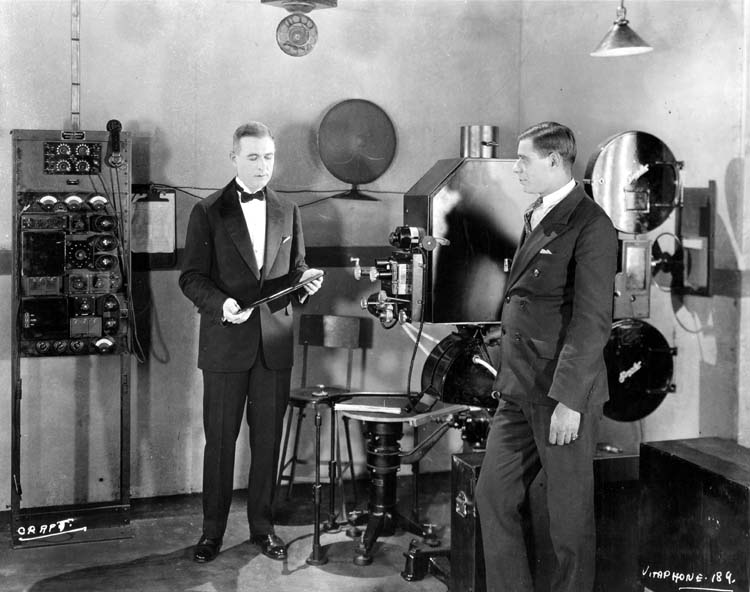
The Jazz Singer was not the first experiment in synchronized sound, nor was it a fully spoken feature. Its importance was commercial. Audiences reacted strongly to hearing a popular performer speak and sing in apparent synchronization with the image, and studios accelerated the conversion to sound production.
Sound-on-disc was soon overtaken by optical sound-on-film. A photographic soundtrack printed beside the picture traveled through the projector with the image, making synchronization more reliable and distribution more practical.
The conversion changed filmmaking almost overnight. Cameras had to be quieted or enclosed in soundproof booths. Microphones were initially difficult to move, which restricted actors and camera placement. Studios built sound stages, theaters installed amplifiers and loudspeakers, and performers whose voices or acting styles did not suit talking pictures faced new challenges.
Early film sound was primarily monaural: dialogue, music and effects were reproduced through one main channel, typically from speakers behind the screen. Although limited by later standards, synchronized dialogue gave filmmakers a new storytelling tool.
Once synchronized sound became reliable, the best directors used it for more than recording dialogue. Fritz Lang's M from 1931 is an important example. The murderer's whistle identifies him before he is visible, while offscreen voices and carefully placed silence create tension.
Lang used sound to make the city feel watchful and dangerous. The soundtrack does not merely explain the image. It creates information, suspense and psychological pressure that the camera cannot provide by itself.
This principle became central to cinema. Footsteps can announce an unseen threat. Music can contradict an apparently happy scene. A sound can begin before a cut and lead the audience into the next location. Good film sound is often most effective when the viewer is not consciously analyzing it.
Walt Disney and conductor Leopold Stokowski treated sound as a central attraction in Fantasia from 1940. The specially developed Fantasound system used multiple recorded channels and additional theater equipment to create directional sound and movement across the auditorium.
The Library of Congress identifies Fantasia as the first animated feature released with stereophonic sound. Its soundtrack was derived from eight recording channels and presented commercially through a four-track system that produced an early form of surround sound.
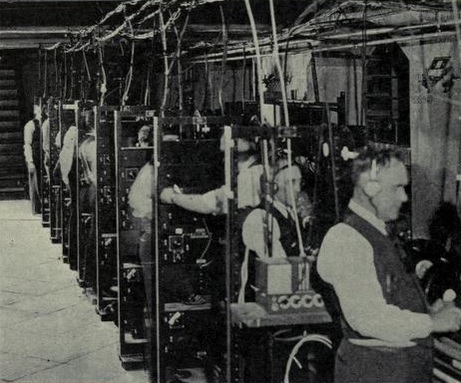
Fantasound was technically ambitious and expensive to install, so it did not become an immediate industry standard. It nevertheless demonstrated that sound could move through a theater and become an immersive part of the presentation.
The widescreen boom of the 1950s renewed interest in stereophonic presentation. Cinerama, CinemaScope, Todd-AO and other premium formats often used multiple front channels and surround effects to match the scale of the enlarged image.
Magnetic stripes placed on release prints could carry several discrete channels with better fidelity than conventional optical mono. Large-format roadshow presentations used sound as a major selling point, but magnetic prints and specialized projection equipment were expensive. Most ordinary theaters continued to rely on optical sound.
Cinema had therefore established the basic layout that remains familiar today: left, center and right speakers behind the screen, with additional speakers around the auditorium for environmental effects. The challenge was delivering that experience economically and consistently to a large number of theaters.
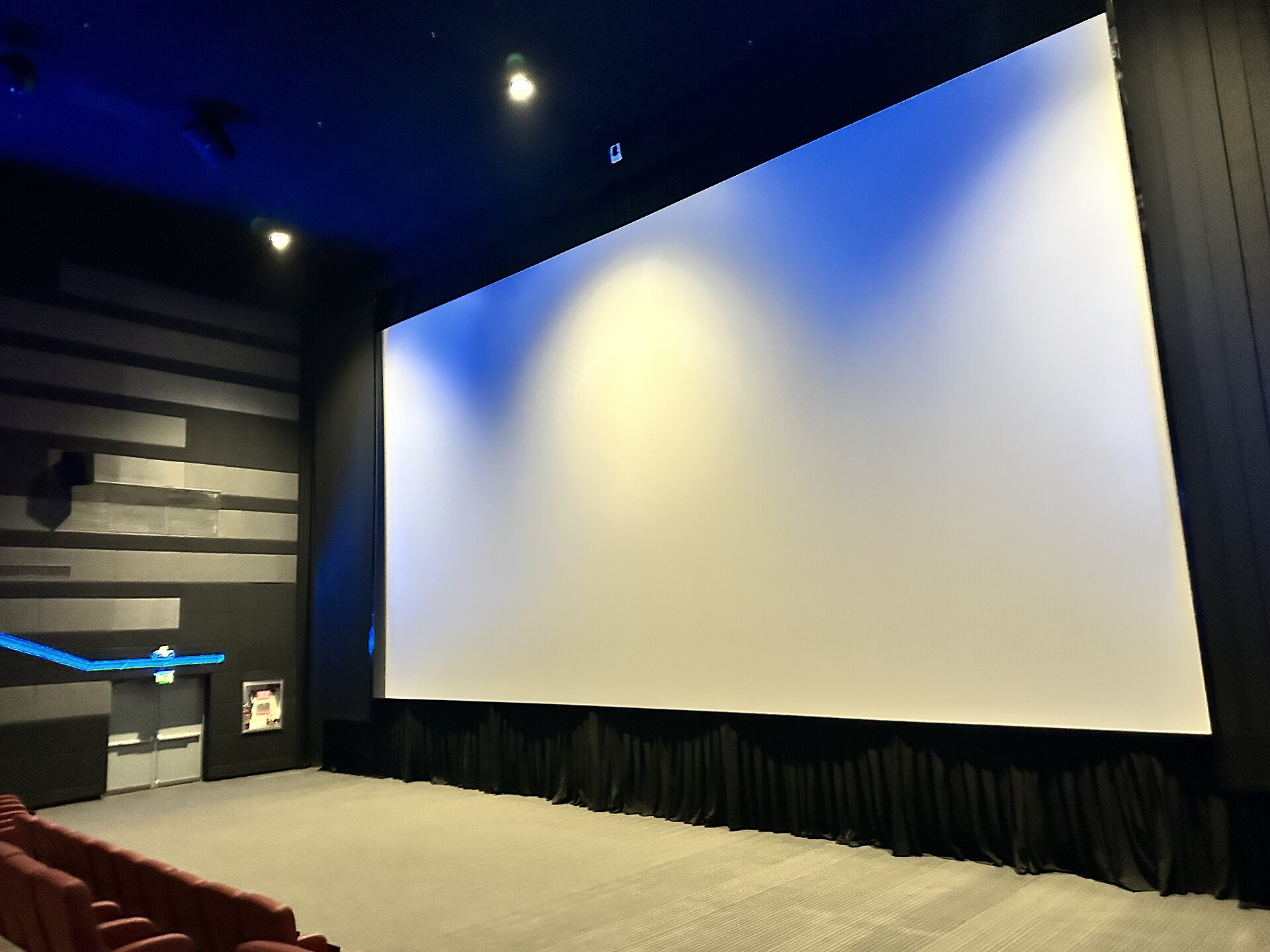
One of the most important features of theatrical sound is not an amplifier or a recording format. It is the ability to place the front loudspeakers behind the projected image. In a commercial cinema, the left, center and right speakers are normally positioned behind an acoustically transparent screen so voices and effects appear to come directly from the actors and objects on the screen.
A conventional solid projection surface would block and reflect too much sound. Acoustically transparent screens solve the problem through either tiny perforations or an open woven structure. The openings allow sound to pass through while remaining small enough that the audience sees a continuous projected image from the intended seating distance.
Stewart Filmscreen has supplied professional and residential cinema screens for decades. Its CinemaPerf option is intended for large cinema-sized applications, while MicroPerf X² THX Ultra uses a dense pattern of precision perforations for smaller screening rooms and home theaters. Stewart also offers Harmony G3, a woven acoustically transparent material designed for high sound transparency and modern high-resolution projection.
Other manufacturers use related approaches. Screen Research offers its woven ClearPix surfaces for speakers placed behind the screen, while Seymour AV offers woven Center Stage materials for residential theaters and professional rooms. The exact weave, perforation size, gain, viewing distance and acoustic attenuation vary by material.
Acoustically transparent screens are especially useful in dedicated home theaters. They allow the center speaker—and often the entire left-center-right front speaker array—to sit at the correct ear height behind the image. This creates the same basic presentation used in commercial cinemas, with dialogue appearing to come from the actors on screen rather than from a speaker placed below the picture.
In a home installation, the screen is commonly mounted on a false wall or framing system with the speakers, subwoofers and acoustic treatment hidden behind it. This can produce a cleaner room design, permit the use of three identical front speakers and improve tonal consistency as sounds move across the screen. The available depth behind the screen, the closest seating distance and the projector's brightness should all be considered before choosing a woven or perforated material.
Perforated and woven screens each involve engineering tradeoffs. The screen must pass sound without introducing objectionable high-frequency loss, visible texture or moiré patterns. It must also preserve brightness, contrast, color accuracy and image uniformity. Speaker distance, screen size, projector resolution and the nearest viewing position should therefore be considered together.
Modern room-correction systems can compensate for modest frequency changes introduced by the screen, but calibration cannot correct poor placement or an unsuitable material. The best result comes from selecting the screen and loudspeaker layout as one integrated audio-video system.
Ray Dolby founded Dolby Laboratories in 1965. The company's first major contribution to film was noise reduction, which lowered audible hiss and allowed soundtracks to use a wider dynamic range.
Dolby's involvement with feature-film sound began during the 1970s. Dolby Stereo combined noise reduction with a matrixed multichannel soundtrack that could be carried on standard optical film prints. Properly equipped theaters could decode left, center, right and surround information, while the same print remained compatible with simpler systems.
Films such as Star Wars helped demonstrate how clearly separated dialogue, music, effects and surround information could increase the impact of a movie. Sound was no longer an optional technical upgrade; it became part of the event.
The 1990s brought competing digital cinema-sound systems. Dolby Digital placed digital information between the sprocket holes of a 35mm print. DTS used timecode on the film to synchronize playback from separate digital media. Sony Dynamic Digital Sound placed digital information along the outer edges of the print.
Dolby identifies Batman Returns from 1992 as the first feature presented in Dolby Digital. Digital 5.1 established six primary playback channels: left, center and right across the screen; left and right surrounds; and a low-frequency-effects channel represented by the “.1.”
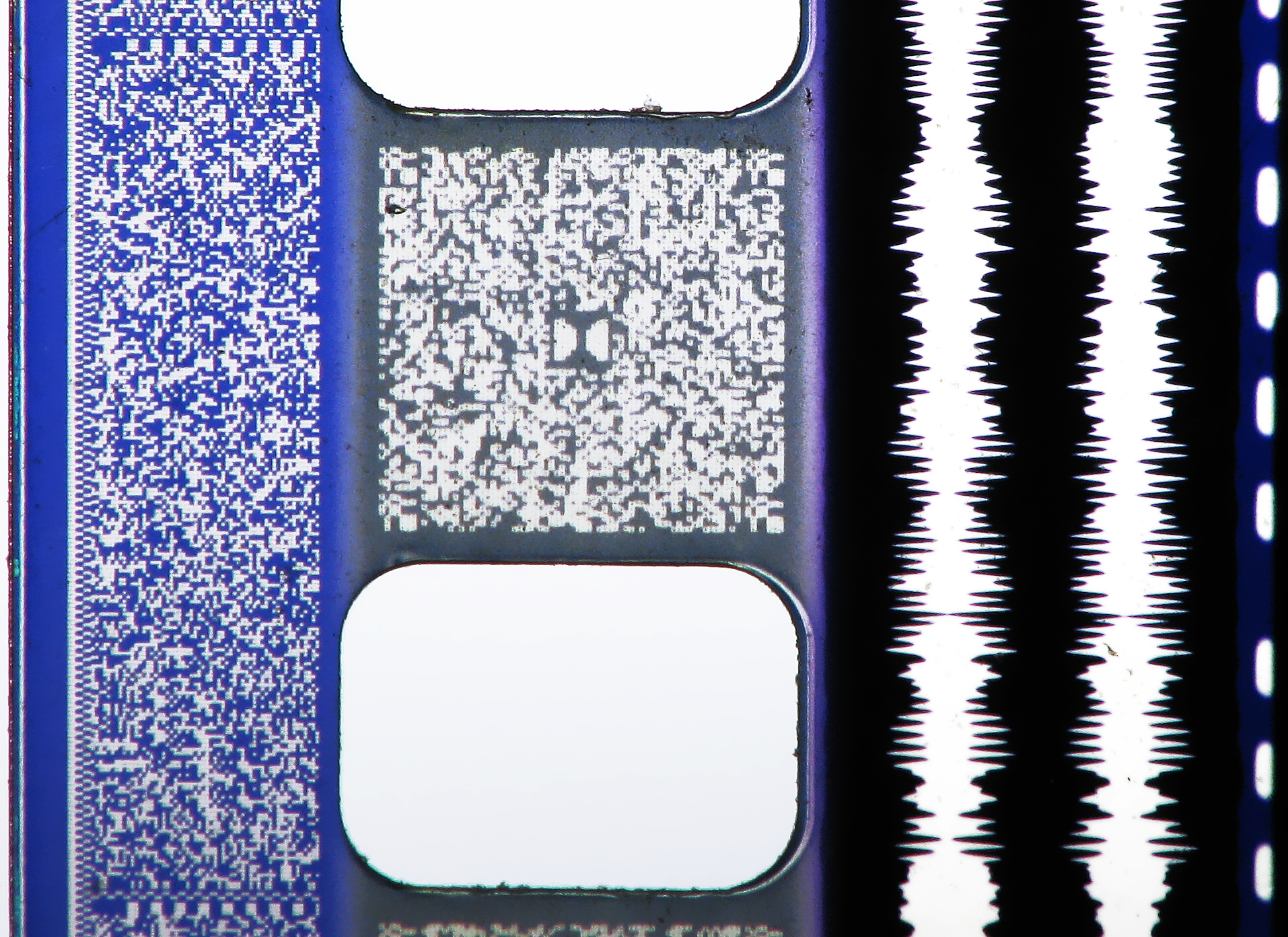
The photograph above shows how several sound formats could coexist on the same physical print. The analog track also provided a dependable backup if a digital reader failed.
Cinema-sound developments eventually moved into living rooms and dedicated screening rooms. Dolby Surround and Pro Logic extracted multiple channels from stereo sources. LaserDisc delivered high-quality analog and digital sound, and selected discs later carried Dolby Digital. DVD made discrete 5.1 playback far more accessible.
That basic 5.1 layout became the foundation of modern home theater. The center speaker handles most dialogue, front left and right speakers establish the main soundstage, surrounds create envelopment, and the subwoofer reproduces deep bass. Later systems added surround-back channels, producing 6.1 and 7.1 configurations.
Traditional surround sound assigns audio to channels. A sound placed in the left-surround channel is reproduced by the speakers assigned to that channel. Dolby Atmos adds a different approach by allowing mixers to treat selected sounds as audio objects with positional information.
An object can be positioned and moved through three-dimensional space. The theater's Atmos processor determines which available speakers should reproduce it. Overhead speakers add the vertical dimension, allowing rain, aircraft, voices or environmental effects to appear above the audience.
Dolby Atmos debuted commercially with Pixar's Brave in 2012. Dolby states that the cinema format can support up to 128 simultaneous lossless audio streams and as many as 64 discrete speaker feeds. The system adapts the mix to the size and speaker configuration of the auditorium.
Home Atmos systems use the same basic idea on a smaller scale. A configuration such as 5.1.2 starts with a conventional 5.1 system and adds two height channels. A 7.1.4 system adds four overhead or height speakers to a seven-channel surround layout. Larger dedicated rooms may use 9.1.4, which adds front-wide channels between the front left-right speakers and the side surrounds while retaining four height channels.
The height channels may use speakers installed in the ceiling, speakers mounted high on the walls or upward-firing modules designed to reflect sound from the ceiling. In-ceiling speakers generally provide the most direct placement, but room construction, ceiling height and seating location all affect the best approach.
An Atmos-capable receiver or processor reads the soundtrack's object and channel information, then renders it for the available speaker layout. A large commercial cinema and a smaller home theater do not use the same number of speakers, but both attempt to preserve the mixer’s intended placement and movement.
The history of cinema sound is not simply a sequence of competing formats. It is the story of filmmakers gaining greater control over space, emotion and point of view. Dialogue became intelligible and anchored to the screen. Music gained depth and dynamic range. Effects moved from a single loudspeaker to the entire room.
The most effective soundtrack does not use every speaker continuously. It uses silence, focus and movement deliberately. A quiet voice from the center of the screen can be more powerful than a room full of effects, while a carefully placed overhead sound can make the audience feel physically present in the scene.
From a pianist watching the screen for visual cues to an Atmos mixer positioning objects in three-dimensional space, the goal has remained remarkably consistent: use sound to make the motion picture more convincing, emotional and memorable.

Alan Hutchinson is the founder and owner of HTmarket.com. He graduated from Babson College in 1984 with a minor in film and has worked in the home theater industry since 2000. His interests include film history, movie theater technology, projection, surround sound and the development of the home cinema experience.
Library of Congress: The Musical Presentation of Silent Films
Library of Congress: The Sound of Silents
Library of Congress: Phonofilm and Vitaphone Equipment
Academy of Motion Picture Arts and Sciences: Sound in Cinema
Library of Congress: Fantasia and Fantasound
Stewart Filmscreen: What Is Acoustic Transparency?
Stewart Filmscreen: Harmony G3 Woven Screen Material
Screen Research: ClearPix Acoustically Transparent Surfaces
Seymour AV: Center Stage Acoustically Transparent Screens
Dolby: Fifty Years of Dolby Feature-Film Sound
Dolby: Batman Returns and the Introduction of Dolby Digital




