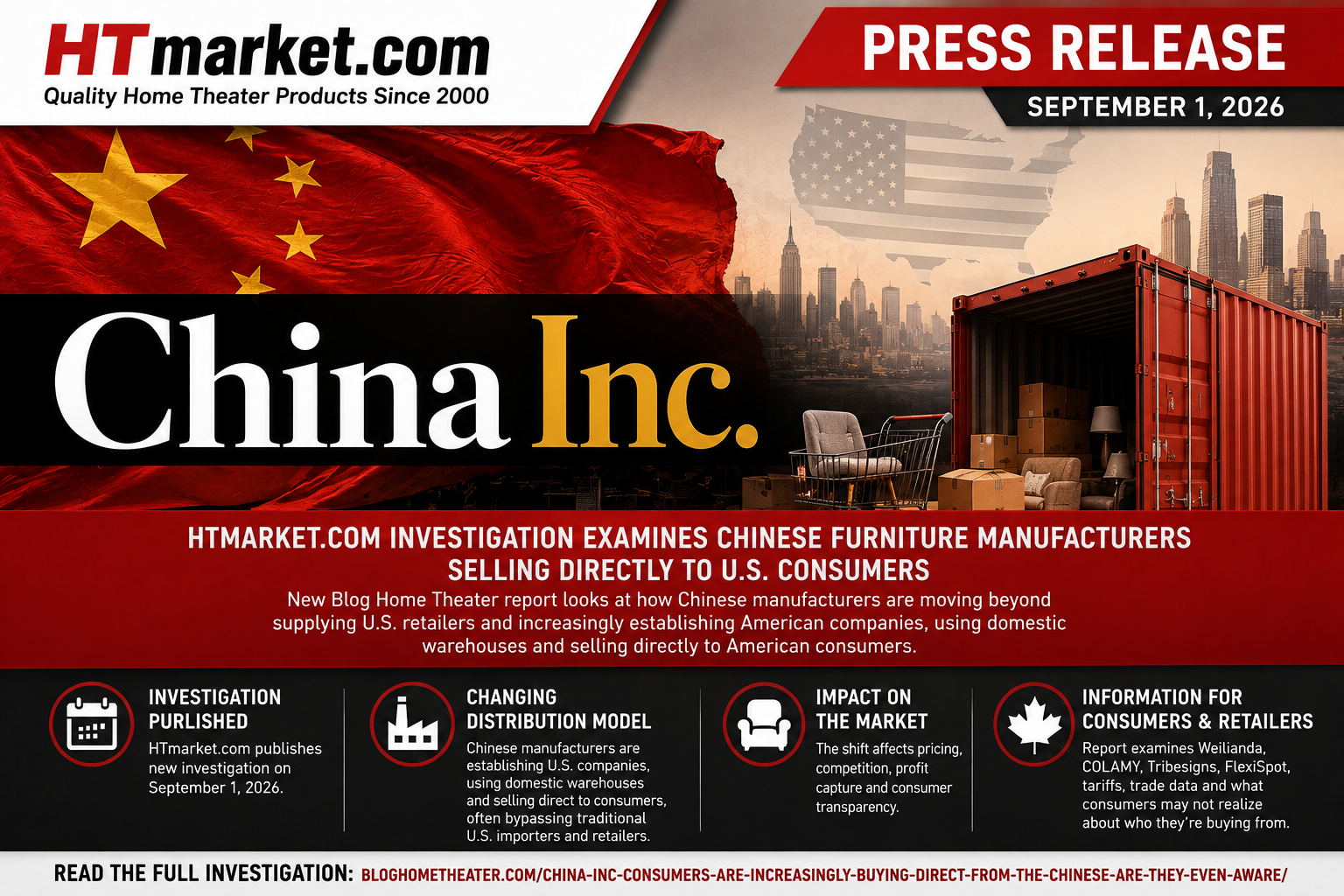
HTmarket.com Investigation Examines Chinese Furniture Manufacturers Selling Directly to U.S. Consumers
New Blog Home Theater report examines how Chinese manufacturers are moving beyond supplying U.S. retailers and increasingly establishing American companies, using domestic warehouses and selling directly to American consumers.
CHICAGO, IL – SEPTEMBER 1, 2026 – HTmarket.com has published a new investigation examining a significant change taking place in the furniture industry: Chinese manufacturers increasingly moving beyond manufacturing and into the American retail channel itself.
The investigation began with research into home theater seating competitor Weilianda, but quickly developed into a much broader examination of Chinese-owned and China-connected businesses establishing U.S. entities, using American warehouses and third-party logistics providers, and selling products directly to American consumers.
“This started as research into one competitor. The deeper I went into public corporate filings, import records, company disclosures and trade data, the more I realized this was a much bigger story. American retailers are no longer simply competing with products manufactured in China. In some cases, they are competing directly with the manufacturers themselves.”
— Alan Hutchinson, owner of HTmarket.com
The Changing Furniture Distribution Model
- Chinese manufacturers have increasingly relocated some production into countries such as Vietnam, Cambodia and Mexico following U.S. tariff increases.
- Some manufacturers are establishing their own U.S. companies or subsidiaries rather than relying entirely on independent American importers and retailers.
- American warehouses and third-party logistics companies allow overseas sellers to provide fast domestic delivery without owning traditional U.S. retail infrastructure.
- A vertically integrated manufacturer can potentially capture manufacturing, importing and retail margins within the same organization.
- The underlying connection to China may be much less visible to consumers than the U.S. company name, American address, toll-free number and domestic warehouse presented on the retail website.
Tariffs Changed the Supply Chain
U.S. tariffs were designed to make Chinese imports more expensive, reduce dependence on Chinese manufacturing and encourage production elsewhere.
Direct imports from China have declined significantly. But the investigation found that the response has been considerably more complicated than simply replacing Chinese production with American production.
Manufacturing has increasingly shifted into countries including Vietnam, Cambodia, Malaysia, Thailand and Mexico. Research from the Federal Reserve has also documented the growing role of Chinese-owned companies in the expansion of exports from countries such as Vietnam to the United States.
In many cases, the first adaptation changed where the product was manufactured without necessarily changing who owned the factory, financed the operation or supplied many of its components.
The Next Step: The Factory Becomes the Retailer
The investigation examines a newer development in which overseas manufacturers move further downstream into the American retail market.
Instead of selling furniture to an independent American importer or retailer, a Chinese manufacturer can establish its own U.S. company, place inventory in an American warehouse or third-party logistics facility, create a U.S.-facing retail website and sell directly to American consumers.
↓
U.S. LLC or Subsidiary
↓
U.S. Warehouse / 3PL
↓
American Consumer
Applicable tariffs still have to be paid.
What can disappear is the independent American importer or retailer that traditionally stood between the foreign factory and the American customer.
Where Does the Consumer's Dollar Go?
The report also examines an important economic consequence of the changing structure.
Under the traditional furniture-import model, an American importer/retailer might purchase a product overseas for roughly one-third of its eventual retail price.
Much of the remaining value supports economic activity in the United States, including tariffs, domestic freight, warehousing, payroll, advertising, customer service, warranty expenses, payment processing, taxes and retailer profit.
When the overseas manufacturer also controls the U.S. importing entity and retail operation, the same foreign-controlled enterprise can potentially capture the manufacturing margin, importing margin and retail margin.
American warehouses, trucking companies and service providers still participate in the transaction, but a larger portion of the ultimate operating profit and enterprise value can accrue to the overseas-controlled company.
“Under the traditional model, America imported the product. Under the emerging direct model, America may also be importing the retailer.”
— Alan Hutchinson
The China Connection May Not Be Obvious to Consumers
Consumer transparency is another issue examined in the report.
An online furniture shopper may see a U.S. corporation, an American business address, an 888 telephone number, domestic inventory, fast shipping and familiar American payment methods.
What may be considerably less prominent is the company's underlying ownership, management or manufacturing relationship with China.
Determining that connection can require examination of state corporate records, trademark registrations, public import records, registered-agent filings and foreign corporate disclosures.
The report does not argue that foreign ownership or the use of U.S. companies and warehouses is improper. Instead, it asks whether consumers have enough information to understand who ultimately owns or controls the retailer from which they are purchasing.
Weilianda and COLAMY Examined
Several furniture companies are examined as case studies, including Weilianda and COLAMY.
Public Colorado corporate filings show that Weilianda Home LLC was originally organized by an individual using a Shenzhen, China address while establishing the company's U.S. presence in Colorado.
Public import records also show Weilianda Home LLC receiving recliner furniture shipments from Chinese suppliers.
The report also examines COLAMY and Aurora Maison Inc., including Colorado corporate-service addresses that overlap with addresses appearing elsewhere in the investigation.
Other examples include Tribesigns and FlexiSpot, which illustrate how Chinese manufacturers and brands can evolve from suppliers into sophisticated U.S.-facing retail operations with American subsidiaries, warehouse networks, marketing operations and direct-to-consumer websites.
Direct Imports From China Fell, But the Trade Deficit Moved
U.S. trade statistics show that the bilateral goods deficit with China has declined substantially.
At the same time, large U.S. trade deficits with countries including Vietnam, Mexico and Taiwan have expanded.
The investigation argues that looking only at the decline in direct Chinese imports may therefore provide an incomplete picture of how global manufacturing networks have adapted to tariffs.
Chinese companies have responded first by relocating some manufacturing and, increasingly, by moving further into the American retail channel itself.
“Did tariffs reduce China's role in the American economy, or did they partly change the form that role takes?”
The Competitive Landscape for U.S. Retailers Is Changing
The traditional concern for American furniture retailers was competition from inexpensive imported products.
The new competitive structure can be considerably different.
An American retailer may increasingly be competing directly against an overseas manufacturer that can potentially control manufacturing, importing, warehousing, marketing and retailing within the same corporate organization.
This gives the manufacturer-retailer access to a much larger economic pool from which to absorb tariffs, freight expenses and aggressive retail pricing.
For independent American retailers, that represents a structural change in competition rather than simply another source of imported merchandise.
The Factory Is Becoming the Retailer
The investigation concludes that the most important development may not simply be where furniture is manufactured.
The more important question may increasingly be who controls the entire commercial relationship with the American consumer.
Under the traditional model, America imported the product.
Under the emerging direct model, America may increasingly be importing the retailer as well.
Read the Full Investigation
The complete article, China Inc., Consumers are Increasingly Buying Direct from The Chinese, are They Even Aware? , is available now on Blog Home Theater.
About HTmarket.com
Founded in 2000, HTmarket.com is a U.S.-based specialty retailer of home theater seating, theater-room furnishings and home theater accessories.
HTmarket.com also develops and markets the HT Design line of purpose-built home theater seating and publishes industry commentary and research through Blog Home Theater.
Media Contact
Alan Hutchinson
Owner, HTmarket.com
Phone: 888-764-9273
Email: info@htmarket.com
Website: www.htmarket.com