We know home theater - 26th Anniversary
Questions? CALL TOLL FREE 1-888-764-9273


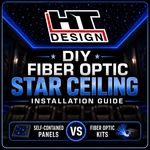
HT Design Star Ceiling Education Guide
A fiber optic star ceiling creates the look of a night sky by using small points of light across a ceiling surface. The effect can be built with loose fiber strands, a light source, and a custom ceiling panel, or it can be built into a self-contained panel system.
Traditional fiber optic kits send light from an illuminator through many individual fiber strands. HT Design self-contained star ceiling panels simplify the concept by building the fiber optic star effect into finished acoustic ceiling panels.
Quick answer: A fiber optic star ceiling works by carrying light through small fiber strands to tiny star points on the ceiling. In a traditional kit, those fibers are installed one by one. In an HT Design self-contained panel, the star effect is already built into the acoustic panel, making the system easier to plan and install.
Most fiber optic star ceilings use the same basic idea: a light source sends light through fibers, and the fiber ends appear as small stars on the ceiling. The difference is how much of that work is done by the installer.
The light source, sometimes called an illuminator or driver, provides the light that travels through the fiber optic strands or panel system.
Fiber strands carry light from the light source to the ceiling surface. The visible end of each fiber becomes a star point.
The tiny illuminated points on the ceiling create the star field. Different densities and layouts create different visual effects.
The ceiling surface can be drywall, fabric-wrapped panels, acoustic panels, or a custom-built ceiling feature.
The system needs power and may be controlled by a wall switch, remote, dimmer, automation system, or separate lighting control.
The ceiling layout determines where the stars appear and how the system works around speakers, projector mounts, HVAC, and lighting.
A traditional fiber optic star ceiling kit gives you the raw parts. The installer still has to build the star ceiling by hand.
Main issue: A traditional kit can create a nice star field, but it is labor-heavy because the installer has to route and finish many individual fibers.
HT Design self-contained panels use the same star ceiling concept, but they package the star effect into a finished acoustic ceiling panel. That changes the project from a loose-fiber installation into a panel layout and mounting project.
Instead of drilling every star point, feeding each strand, gluing fibers, trimming ends, and hiding a remote illuminator, the installer focuses on panel placement, power, alignment, and clean installation.
| How It Works | Traditional Fiber Optic Kit | HT Design Self-Contained Panel |
|---|---|---|
| Star effect | Built by routing individual fibers | Built into the finished panel |
| Installation focus | Drilling, routing, gluing, trimming fibers | Panel layout, mounting, and low-voltage power |
| Ceiling surface | Depends on installer-built panel, drywall, or fabric surface | Finished acoustic panel surface |
| Fiber handling | Loose fibers managed by installer | Fibers are contained inside the panel system |
| Best fit | Open ceilings and hands-on custom work | Finished home theaters and cleaner upgrades |
A star projector throws light onto the ceiling from a device in the room. A fiber optic star ceiling creates points of light at the ceiling surface itself.
That difference matters in a home theater. A projector effect can look temporary. A fiber optic star ceiling looks more like a built-in architectural feature.
| Feature | Star Projector | Fiber Optic Star Ceiling |
|---|---|---|
| Light location | Projected from a device | Light appears from points in the ceiling |
| Appearance | Temporary lighting effect | Built-in ceiling feature |
| Room integration | Device sits in the room | Integrated into the ceiling design |
| Best use | Casual rooms and temporary effects | Dedicated home theaters and finished rooms |
Star density is the number of star points in a ceiling area. Higher density can create a more dramatic sky effect, but more is not always better. The best layout depends on room size, ceiling height, seating position, and the overall theater design.
Creates a calmer, more subtle night-sky effect. Good when the theater design is clean and restrained.
Often the best balance for home theaters. The star field is visible without overwhelming the room.
Creates a more dramatic ceiling effect. Best for larger rooms or theater designs where the star ceiling is a major focal point.
Every fiber optic star ceiling needs power. In a traditional kit, the illuminator usually needs a location with power and access. In a self-contained panel system, the layout usually focuses on the driver, leader cable, jumper cables, and panel-to-panel power path.
HT Design surface-mount panels use low-voltage power, with a driver supplying the system and jumper cables connecting panels. Planning power before installation is important because the driver and wiring path should remain practical and serviceable.
The star ceiling effect depends on layout as much as product choice. A good layout works with the seating area, screen wall, projector, Atmos speakers, HVAC vents, soffits, and lighting.
The star field usually looks best when it is centered over the main seating area or the full seating zone.
Avoid crowding the star field too close to the screen if it distracts from the viewing experience.
Leave room for the projector mount, lens path, wiring, and service access.
Plan speaker locations before finalizing panel layout so the ceiling system does not conflict with audio placement.
Do not block supply vents, returns, or access points. Airflow should be planned before panels are installed.
Plan around recessed lights, soffit lighting, LED strips, sconces, and dimming controls.
In a home theater, the ceiling is not only decorative. Surfaces in the room affect how the theater sounds. That is why star ceiling panels with acoustic construction are a better fit than purely decorative panels or temporary projectors.
HT Design star ceiling panels are acoustic panels with the star effect built in. This helps the star ceiling fit into the room’s acoustic design. They should not be described as a complete soundproofing system, because soundproofing depends on the full construction assembly.
| Myth | Reality |
|---|---|
| “A star projector is basically the same thing.” | No. A projector throws light onto the ceiling. A fiber optic star ceiling creates light points in the ceiling surface. |
| “A fiber optic kit is easy because the parts are simple.” | The parts may be simple, but the labor can be extensive. Traditional kits require layout, drilling, routing, securing, and trimming. |
| “More stars always looks better.” | Not always. Star density should match the room size, ceiling height, and theater design. |
| “Acoustic panels are soundproofing.” | No. Acoustic panels can help with room acoustics, but soundproofing depends on construction, sealing, mass, and isolation. |
| “Power can be figured out later.” | Power should be planned before installation so drivers, cables, switches, and service access are handled correctly. |
The biggest difference is what happens behind the ceiling surface. Traditional kits require a large amount of hidden fiber routing. Self-contained panels keep the star system inside the finished panel, reducing the amount of loose fiber work at the job site.
| Behind the Ceiling | Traditional Kit | HT Design Self-Contained Panel |
|---|---|---|
| Loose fibers | Many fibers routed by hand | Contained inside the panel system |
| Illuminator planning | Remote illuminator location must be planned | Panel system uses planned low-voltage power and driver layout |
| Ceiling access | Open access makes installation easier; finished ceilings are harder | Better suited for finished theater upgrades |
| Service concerns | Depends on where illuminator and fibers are routed | Power and panel layout can be planned more cleanly |
The best choice depends on the room. Traditional fiber optic kits work best when the ceiling is open and you want complete control over every star location. Self-contained panels work best when you want a finished theater ceiling with less installation complexity.
| Project Type | Best Option | Why |
|---|---|---|
| Temporary effect | Star projector | Simple and removable, but not a built-in ceiling feature. |
| Hands-on custom DIY project | Traditional fiber optic kit | Gives full star placement control if you accept the labor. |
| Finished home theater upgrade | HT Design self-contained panels | Cleaner installation path with the star effect already built into the panel. |
| Luxury new construction | Custom fiber optic ceiling or custom HT Design layout | Best when the ceiling is part of a full custom room design. |
A fiber optic star ceiling works by sending light through fiber strands to small star points on the ceiling. A traditional kit makes the installer build that system one fiber at a time. That can work, but it is labor-heavy.
HT Design self-contained star ceiling panels make the process easier by building the star effect into finished acoustic panels. For many home theaters, that is the smarter approach: a real star ceiling effect, a cleaner finished look, and less installation complexity than a traditional fiber optic kit.
A light source sends light through small fiber strands. The visible ends of those fibers appear as tiny stars on the ceiling.
No. A star projector casts light onto the ceiling from a device. A fiber optic star ceiling creates light points at the ceiling surface itself.
Yes. Traditional systems use fiber strands routed to star points. HT Design self-contained panels have the star effect built into the panel system.
Traditional kits require the installer to lay out star locations, drill holes, feed fibers, secure strands, trim the ends, and plan the light source location.
Self-contained panels build the fiber optic star effect into the finished panel. The installer focuses on panel layout, mounting, power, and alignment instead of routing every fiber by hand.
HT Design star ceiling panels are acoustic panels with the star effect built in. They can help integrate the star ceiling into the room’s acoustic design, but they are not a complete soundproofing system.
Plan the room size, seating layout, projector location, ceiling speakers, HVAC vents, lighting, power source, driver location, and panel layout before installation begins.
Call HTmarket.com at 1-888-764-9273 for help comparing HT Design self-contained star ceiling panels, traditional fiber optic kits, and custom star ceiling layouts for your home theater.
Product availability, URLs, sizes, power requirements, installation requirements, prices, and specifications may change over time. Confirm current product details and local code requirements before ordering or installing.